We answer common questions and raise a bigger one: “How is the economy we build with AI going to be more or less sustainable than the old one?”
We all play a role in this frontier moment for humanity
At Third Partners we are heavy users of GenAI tools for sustainability consulting applications and fun personal projects alike. Our early GenAI-fueled business applications help busy managers save time and money by automating their most mundane and complex sustainability reporting and analytics tasks. The results have been dramatic — days of research and synthesis condensed into a few hours.
But we are just scratching the surface. Our aspirations for AI’s positive global impact extend far beyond its current applications by us or others.
“AI is already changing our relationship with information. Just like the Internet democratized access, AI is democratizing creation and leading to a surge in volume. We need to ensure this mountain of new content actually increases value. AI’s success depends on its ability to enhance human understanding and ability, not just regurgitate what already exists.” said John Haugen, Co-Founder and Principal at Third Partners.
AI certainly presents a social and environmental dichotomy: it can either facilitate societal decay through tools like war machines, financial instability, and increased inequality, or it can be a catalyst for human advancement, aiding in cancer cures, promoting clean energy, and fostering educational and income equity.
Currently, we are in a transitional phase, exploring the true nature and trajectory of this technology.
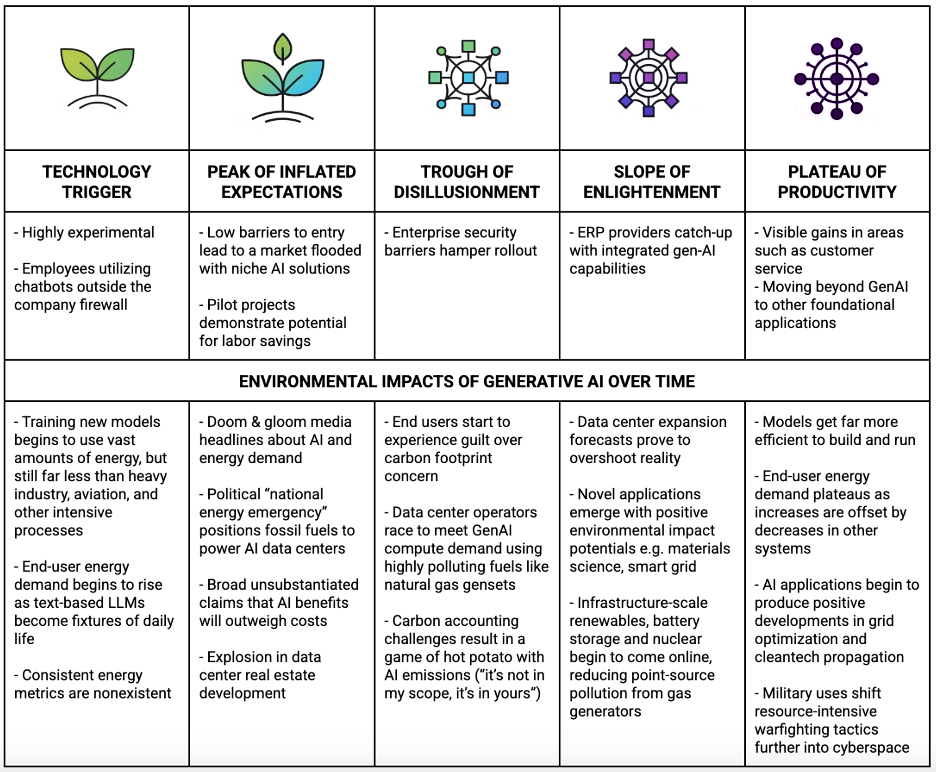
The Environmental Impact of GenAI Will Change Over Time
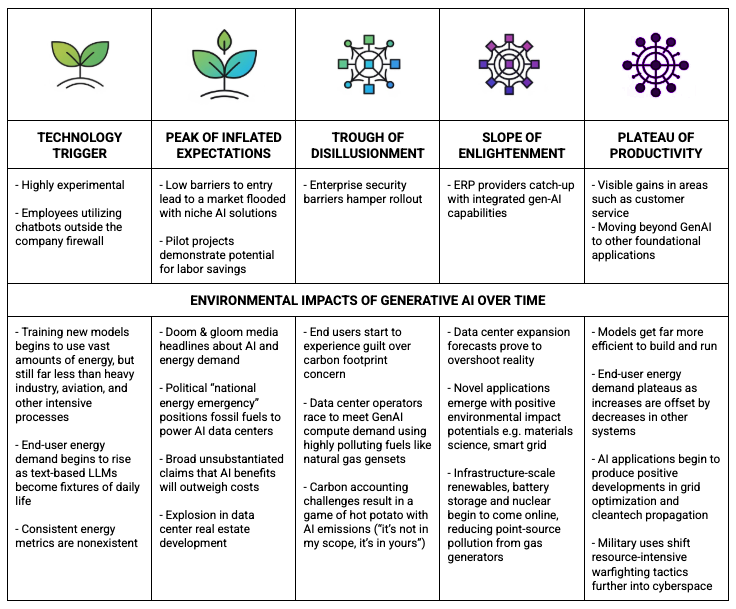
Understanding the stages of the Hype Cycle “allows companies to adopt technology strategically, based on readiness and relevance.” As the role of GenAI in the economy grows, so will its environmental impacts — both benefits societal costs.
Jesse Thorson, a Manager at Third Partners said, “What we are hearing from tech executives, who have no choice but to hype AI technology to infinity and beyond, feels like a familiar pitch: despite initial costs from pollution and job losses, the benefits will outweigh the harm, leading to more leisure time, and elevated social & economic status for all. Can we truly trust those who claim AI will be a net positive? This is some slippery calculus and gives us false confidence in the long-term impacts of AI on society, positive & negative.”
As we consider whether to turn internal GenAI tools into widely available ones, we have also explored the question that many sustainability managers and end-users of GenAI are asking: how is AI going to impact the natural environment today and as the technology propagates.
Is AI environmentally sustainable?
By looking to past technologies, we’ve learned how wildly inaccurate future predictions can be when they are based upon the current nascent state of a technology like GenAI.
When the internet was growing rapidly in the late 1990s, some analysts projected that IT would account for half of U.S. electricity use within a decade. That turned out to be totally false. Thirty years later, IT-related emissions are still less than 4 percent of global GHG emissions (about 4.4% in the US).
Consider another case: the rise of streaming video services. As streaming exploded globally, there was huge concern about runaway energy usage for data centers (yes, binge watching the first two seasons of The Bear in hi-def does in fact take as much data bandwidth as downloading all the text on Wikipedia. As of 7/22/2025 Wikipedia’s text library size is 25GB. Streaming hi-def video is about 3GB per hour.)
But the rise of streaming video ushered in the death of the set-top CATV box (remember those energy hogs?). Then came LCD and LED smart TVs with integral streaming apps that drastically improved energy efficiency. Finally, a shift to mobile viewing has further lowered streaming’s energy impact. Today, the energy impact of streaming video remains fairly modest.
We believe it is critical for business leaders and sustainability managers to avoid generalizing, compartmentalizing, and over-estimating the environmental impact of GenAI at the expense of exploiting the technology to produce game-changing outcomes.
“Within the sustainability space there’s an immediate tendency toward bean counting our way to myopic conclusions about the environmental impact of AI,” said Adam Freedgood, Co-Founder and Principal at Third Partners.
“GenAI is here to stay and we need to channel way more energy into racing toward bigger, more consequential opportunities for GenAI to accelerate efforts to protect a liveable environment.” Freedgood added.
Q&A on GenAI, energy and GHG emissions
More companies and individuals are beginning to experiment with GenAI tools. New AI features will continue to pop up in existing cloud-based software tools, from the Microsoft Office suite to Google, and Salesforce.
As this trend continues, we’ve received smart questions from clients about the AI tools they use today. Some are straightforward and some have more nuanced answers.
Q: Will AI increase electricity consumption?
A: Yes, but if history repeats itself, the impacts are far from certain, likely to be overstated based on current hype, and may be offset by energy savings and carbon emissions reductions in other areas as AI technologies mature. As a rule of thumb, an LLM request consumes up to 10 times more energy than a conventional Google search. But, these are different tasks and in both cases, the total energy consumption for an individual user is very small — roughly equivalent to the energy being used at any given time by a typical home office setup (lighting, PC, monitor, accessories). An MIT study puts it another way; getting a response from their largest text generation model is like running a microwave for 8 seconds.
Q: Is expanding AI usage bad for our company’s “carbon footprint?”
A: For the majority of firms that use LLM-based AI tools such as chatbots and AI features within existing cloud software tools, AI usage will contribute less than 5 percent of the company’s total carbon footprint for the foreseeable future. That’s the rule of thumb we’ve seen from 15+ years performing GHG inventories and carbon emissions studies for companies. Relative measures may not be important for some companies. If IT related emissions rise, it could undermine progress on decarbonization goals. As far as IT services go, LLMs are inherently inefficient. They are essentially brute force guessing machines and that comes with a large energy cost. How significant is this to an individual user? A company? It comes down to spend. Companies that spend a large percentage of their operating budget on AI services will derive a larger portion of their enterprise GHG emissions from that spend relative to other services.
Q: Are there any ways AI usage might decrease a company’s carbon footprint?
A: At the scale of one individual company or group of AI users, yes, there are cases where there may be a silver lining. As AI begins to augment or replace certain business services and functions that employees used to handle, companies are likely to see savings in certain areas. As a cruel example, consider a company that rolls out LLM tools to replace certain coding jobs. LLMs do not have to commute to work, they don’t need office space, they have no air travel budget, and they don’t eat snacks from the company cafeteria. In GHG reporting jargon, this would result in a shift in some Scope 1 and Scope 2 emissions into the Scope 3 category.
Q: Is the possibility of reduced environmental impacts from AI usage actually something to celebrate?
A: We don’t think so. There are ways for companies in every sector to reduce GHG emissions and grow the business without resorting to attrition. Big Tech firms’ hiring of new grads dropped about 50% from pre-pandemic levels, in part to AI adoption; an AI CEO warns that 50% of all entry-level office jobs are at-risk, according to recent reports.
The social costs of rapidly replacing millions of jobs with AI would be a catastrophic near-term shock, perhaps even greater than the impacts from automation and globalization that led to the “rust belt” throughout the 70s and 80s. When the workforce is struggling, we will have a very hard time managing solutions to many environmental challenges from energy and emissions to water and biodiversity.
Q: My firm will be a heavy AI user, how can we minimize the environmental impact of our AI usage?
A: Smart businesses will follow the same playbook that’s been used for decades to buy low-carbon IT services and SaaS products. It comes down to supplier engagement and environmentally-preferred procurement standards. When buying IT services, evaluate the energy and emissions profile of suppliers. Suppliers that cannot provide data and clear answers will be difficult to work with when it comes to reducing corporate GHG emissions or setting targets that involve carbon emissions from AI services. We find that suppliers with weak environmental commitments also tend to have social and ethical risks lying below the surface.
Q: We already measure and report our carbon footprint; will AI-related carbon emissions fall into Scope 1, Scope 2, or Scope 3?
For most companies, IT emissions from cloud services fall into Scope 3 (indirect). Increasingly, companies are accountable to investors and buyers to reduce emissions across all three scopes. One AI provider, Mistral AI, breaks down the life cycle carbon emissions of their AI service.
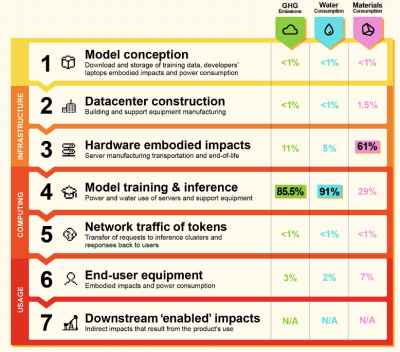
The majority of AI energy, water, and materials consumption and GHG emissions relate to model training and inference.
Training: the initial process of developing a model
Inference: Occurs continuously on servers in response to user requests.
Q: Electricity prices are on the rise in states like Georgia, Virginia, and Pennsylvania that host, and plan to expand, AI data centers. How much of this is actually due to AI?
The picture is different state by state but the short answer is that growth in AI data centers is just one of several factors currently pushing electricity prices higher for American ratepayers. Certain regions of the U.S. grid have had very tight capacity margins before AI that would be exacerbated by the construction of gigantic data centers near major population centers.
While the current plan is for those AI data centers to secure their own electricity generation using contracts with utilities and self-generation, we are already seeing spikes in electricity prices in and futures in many states. Consumer advocates say it is partially a result of rising AI-related demand and inadequate protections for ratepayers.
Q: Is AI creating an “energy emergency” in the U.S.?
The notion that an AI race will create an “energy emergency” is overblown political theater, at least for now. As governments pursue AI dominance, there will be pressure on regulators and utilities to prioritize the interests of big tech companies over other users such as businesses, schools, hospitals, and homes. It is important to monitor regulation in your state and join up with consumer advocacy groups if you are concerned about rising electricity prices.
The GenAI frontier likely comes with a fork in the road
The Third Partners team challenges business leaders to ask more than “what’s the carbon footprint” of GenAI cloud services at today’s critical juncture.
Bigger picture, how is the economy we’re building with AI going to be more or less sustainable than the old one?
The answer to this question will ultimately help put the energy, water, carbon and raw materials impacts of GenAI into the appropriate historical and planetary perspective.
—
About the Author: Adam Freedgood