How is GIS used in corporate sustainability?
GIS, or Geographic Information Systems, refers to tools used to analyze geospatial data, identify trends, and understand how they relate to our surroundings. While GIS has long been applied in the natural sciences, GIS is now a critical technology for simplifying complex environmental reporting challenges. GIS solutions are a critical tool for streamlining voluntary reporting such as CDP, SASB and TCFD. Some of the regulatory requirements that require a GIS-heavy approach include California SB 261 and EU regulations: EUDR, CSDDD and CSRD.
From building new sales and marketing solutions to automating supply chain risk mapping, the “eye in the sky” offered by today’s advanced GIS capabilities can give brands a competitive edge while solving major sustainability challenges. Most companies do not have in-house expertise to handle complex, geospatial data and analysis. We can help.
8 ways GIS technology helps solve critical corporate sustainability challenges
- Sales enablement. Need to pinpoint exactly where your solutions can make the greatest impact for customers? Our GIS-based product and market development solutions help companies establihs product-market fit with pinpoint precision. This is especially important in business sectors that involve land use, including environmental services, food & ag, real estate, utility-scale and commercial solar.
- Environmental risk assessment, monitoring and reporting. The same tools that have been used by the insurance industry for decades are now available to companies to help meet environmental risk assessment and reporting requirements. Risk assessment and mitigation is a requirement of many sustainability and ESG reporting standards and an increasing number of state, provincial and national laws. Only GIS-powered solutions are capable of analyzing the immense volumes of data involved in upstream and downstream supply chain environmental risk mapping.
- Comply with emerging regulations. An increasing number of sectors are subject to environmental protection standards. For example, the EU Deforestation Regulation (EUDR) goes into effect in 2026. Companies placing products on the EU market must meet rigorous supply chain mapping, forest plot geolocation, and deforestation risk assessment requirements. GIS analysis, combined with supply chain engagement and other programmatic tools, can help your organization reduce the time it spends complying with these new anti-deforestation, traceability and transparency requirements.
- Implement and monitor biodiversity commitments. How do your physical operations and supply chain impact biodiversity? Use geospatial analysis to identify risks & hotspots in your operations & extended value chain.
- Set responsible sourcing commitments and monitor performance. Once you have mapped your supply chain to measure social and environmental performance among direct and indirect suppliers, we use GIS analysis to overlay a variety of risk metrics specific to your sourcing regions. This allows buyers to pinpoint sources of risk, more effectively target field audits, and investigate corrective actions.
- Perform Environmental Risk Assessment for Site Selection. The only way to prove that your development projects create a net positive environmental and social impact is to study and mitigate risks related to land acquisition, project siting, construction and potential disproportionate impacts on marginalized communities. GIS studies may be conducted as part of a state-mandated EIA, or voluntarily as part of a broader corporate sustainability commitment.
- Assess climate change risk. Geophysical risks of climate change include sea level rise, increases in extreme precipitation, water scarcity, heat stress, and more. If your organization is required to disclose climate-related risks using CDP, TCFD, SASB, EcoVadis or other frameworks, GIS studies can streamline your reporting and improve your standing relative to peers and competitors. The insurance and risk industries have embedded GIS in their hazard assessments and pricing models for decades. Now, the same powerful predictive analytics capabilities are available to companies to better manage risk and meet heightened sustainability reporting obligations.
- Engage with stakeholders. It can be difficult to message on sustainability benefits. With GIS, you can leverage the latest in satellite imagery and AI-powered analysis to bring your strategies to life by creating visualizations that demonstrate your impact.
Third Partners GIS Services Expertise
Interactive, Visual Tools For Customers
With our GIS capabilities, we can enhance communication strategy with dynamic maps and dashboards that provide transparency to customers including buyers and retailers.
Easily Updated, Year-Over-Year Tracking
We use remote sensing technology to create a clear, effective system for tracking progress on environmental risks over time.
Meet Regulatory and Stakeholder Requirements
GIS tools make complex data easier to understand. Certain regulations, including EUDR, require companies to share GIS supply chain data with regulators.
New Market Opportunities
Unlock new top line growth opportunities by creating data-driven tools and resources that your sales team can leverage.
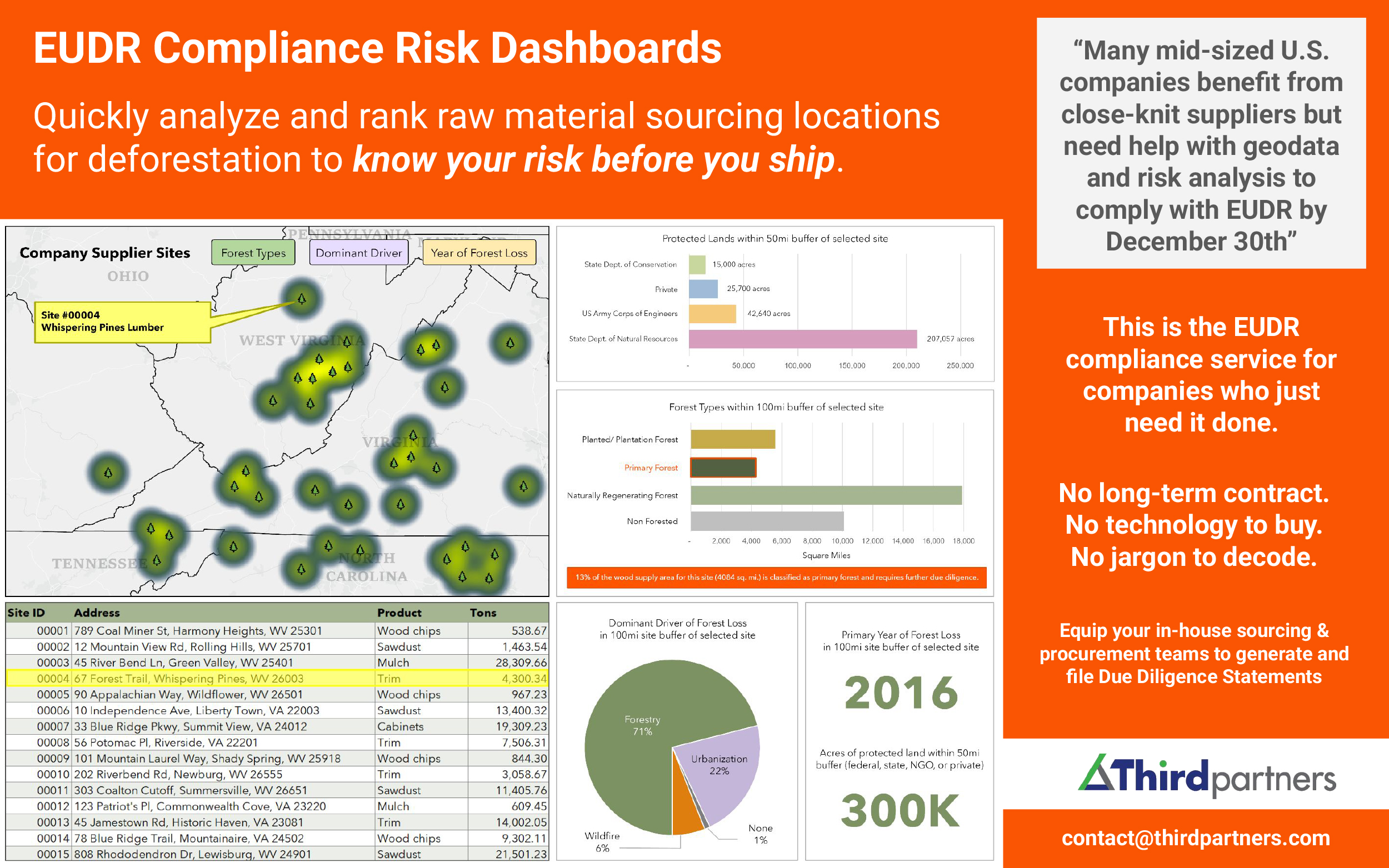
Third Partners’ EUDR Compliance Risk Dashboard is one example of how we apply GIS technology to help clients pinpoint and eliminate supply chain environmental risk. Clients get a rapid report based on known sourcing data, which is then used to inform the due diligence and compliance process. “Know your risk, before you ship” is essential for U.S. exporters of wood products, beef, packaging and other covered materials to avoid costly container holds, seizures and fines. Third Partners can run the risk assessment using any level of existing supply chain data that companies have, including supplier lists. The report indicates likely risk hotspots based on the EU definition of deforestation. The same technologies and consulting service can be applied to any environmental risk assessment challenge where companies are working with uncertain supply chain data and need to analyze a number of satellite-based datasets.
Our Approach to GIS Services
Talent spotlight: Meet our GIS expert consultant Kylie Tokar

Kylie holds a B.A. in Geography from the University of South Carolina and a M.S. in Geospatial Information Science from the University of Maryland. She has been working as a consultant with the Third Partners team for the past year and brings a wealth of experience creating geospatial solutions for environmental issues. We want to highlight two of her past projects that demonstrate how GIS is used for ESG.
Community Data Snapshots for the Chicago Metropolitan Agency for Planning: This is a great example of the type of interactive web map that can be created with GIS tools. In this particular project, users can explore a dashboard of demographic data from the Chicago area. This type of product could directly translate to mapping suppliers or showing progress on social initiatives.
Community Data Snapshots for the Chicago Metropolitan Agency for Planning: This is a great example of the type of interactive web map that can be created with GIS tools. In this particular project, users can explore a dashboard of demographic data from the Chicago area. This type of product could directly translate to mapping suppliers or showing progress on DEI initiatives internally.
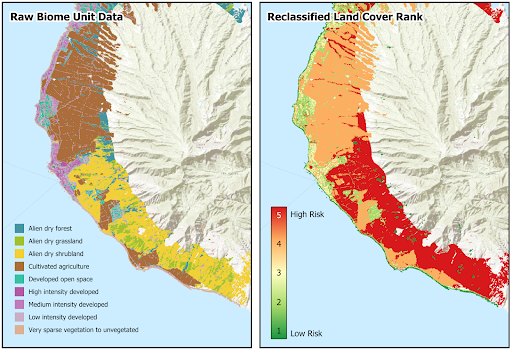
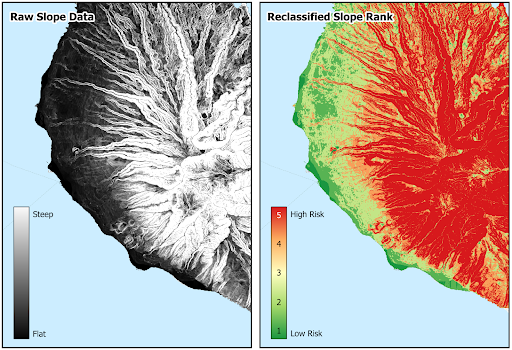
Wildfire risk analysis: Variables including slope, soil type, precipitation, and vegetation are indicators of wildfire risk. GIS is a useful tool for pulling in all of these variables and developing a risk model. Below are some examples of raster maps of risk layers in Lahaina, Hawaii.

Case Study
Using GIS Technology to Assess Climate Risk, Biodiversity Risk, and Organic Waste Diversion Feasibility for Hyatt Hotels

Hyatt Hotels & Resorts was subject to a number of investor-driven ESG and sustainability reporting mandates. In addition, the sustainability team was working on ways to divert organic waste from landfills across a national and international portfolio of properties.
Hyatt turned to Third Partners to develop a GIS-backed solution that would remotely analyze thousands of hotel properties for a number of risk factors and sustainability-linked business opportunities. Working with our long-term business partner, Sourcemap, a leading provider of supply chain mapping and risk analysis solutions, Third Partners designed and launched a GIS-backed dashboard to help Hyatt automate its SASB reporting on water risk, flood risk, and biodiversity risk across thousands of hotels and resorts.
The dashboard pulled in data from multiple government and NGO databases to provide Hyatt with an instantaneous set of data to meet its SASB reporting requirements. In addition, Hyatt was interested in developing strategies to divert organic waste from landfills; however, the feasibility of doing so varies at each hotel according to a number of environmental, operations, and geographic factors. Third Partners designed a GIS-based solution to Hyatt’s organic waste diversion problem — creating a custom dashboard that ranks organic waste diversion feasibility across thousands of hotels and resorts. Third Partners utilized datasets from the U.S. EPA and devised an opportunity scoring algorithm that helped to screen hotels for compliance risks vs. beyond-compliance opportunities.
Geographic Information Systems (GIS) Services FAQs