From a federal policy perspective there’s a lot of friction surrounding sustainability in the U.S. But how much has actually changed for businesses? In this interview, Third Partners co-founder Adam Freedgood answers common questions about corporate sustainability strategy in 2026.
Listen to a podcast style summary of these insights:
Jump To:
How would you describe the overall state of corporate sustainability as we head into 2026? What’s changed in the past 12-18 months?
How have recent U.S. federal policies impacted the state of sustainability, both domestically and worldwide?
Are there any laws/regulations on the horizon for 2026? Are any states opting to enact stricter regulations in response?
Are you seeing companies double down on, pause, or rethink initiatives—or shift away from compliance towards other goals?
What do you foresee being “hot topics” for sustainability in 2026?
How do sustainability regulation differences between the U.S. and Europe affect American companies competing in global markets?
How has the manufacturing sector been uniquely impacted by sustainability pressures over the past year?
What’s happening in the healthcare sector in relation to sustainability?
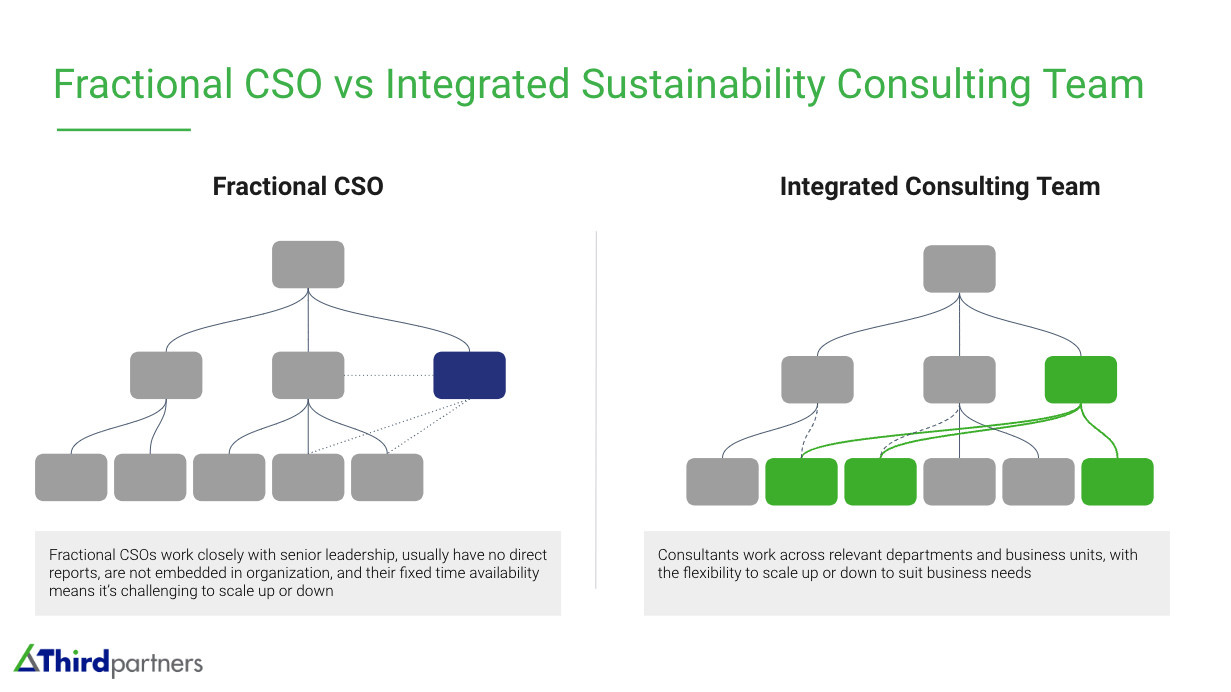
Why are more organizations exploring fractional CSOs rather than building full in-house teams?
If you could offer one piece of advice for C-level executives thinking about sustainability in 2026, what would it be?
How would you describe the overall state of corporate sustainability as we head into 2026? What’s changed in the past 12-18 months?
There is less appetite for vanity projects and that’s a good thing. In 2026, we’ve officially exited the era of sustainability as a marketing story and entered the era of sustainability as an operating system. For leaders who are accountable to a variety of stakeholders, the middle of the decade reality has set in. Companies are no longer being rewarded for 2030 promises but are instead being scrutinized on actual performance.
The alphabet soup of bloated reporting mandates hasn’t disappeared, but it has fragmented. It is now a gauntlet of requirements from specific buyers, state-level regulatory mandates, and voluntary practices that support competitiveness through differentiation. Facing a backdrop of civil unrest and economic volatility, there is no room for performative ESG. If a program doesn’t create shared value for both the business and the community, it should be reconsidered. This year more clients are asking us to support execution in areas that prioritize the bottom line and community resilience.
Table 1: Some of the dozens of ESG and sustainability frameworks companies use for metrics and reporting
| OECD /UNGP | UNGC | SASB | TCFD | GRI | CDP | SBTI | LEED | B CORP | LCA/EPD | |
|---|---|---|---|---|---|---|---|---|---|---|
| Corporate risk reduction focus? | YES | YES | NO | NO | YES | YES | YES | NO | NO | NO |
| Corporate risk disclosure focus? | NO | NO | YES | YES | YES | YES | NO | NO | NO | NO |
| Societal value focus? | YES | YES | NO | NO | NO | NO | YES | NO | YES | YES |
| Minimum performance standards? | NO | YES | NO | NO | NO | NO | YES | YES | YES | NO |
| Comprehensive social, environmental scope? | YES | YES | NO | NO | YES | NO | NO | NO | NO | NO |
| Easily measurable business ROI? | NO | NO | NO | NO | NO | NO | NO | NO | NO | NO |
How have recent U.S. federal policies impacted the state of sustainability, both domestically and worldwide?
The federal landscape is, frankly, a disaster for science, health and wellbeing. We are seeing a pivot toward radical deregulation and ill-informed policies. If you want to call it policy. The EPA no longer weighs the cost of human lives when regulating pollutants. There’s an outright national ban on offshore wind energy that’s creating a huge hole in the ability of states to meet demand for inexpensive electricity. Federal support for utility scale solar is waning while subsidizing LNG exports. Together, this contributes to rising electricity prices.
Furthermore, the U.S. is alienating itself by pulling out of over 60 international organizations, including the WHO, IUCN, and the IPCC. These rollbacks hand China the lead in the clean energy transition and set the U.S. back years. We are in a precarious position where federal isolation puts both people and the economy at significant risk.
For corporate leaders, the federal government’s war on facts and science is best understood through three major blind spots it creates:
1. The Criminalization of Reality By labeling climate scientists and advocates as “environmental insurrectionists”—as the President did during Winter Storm Fern in January 2026—the administration has moved from skepticism to hostility. For businesses, this reinforces a culture of greenhushing. Leaders stay quiet to avoid being caught in a political dragnet, but simultaneously lose the ability to speak honestly with employees and customers who are living through these climate realities.
2. Losing our “Eyes and Ears” The federal government’s dismantling of the National Center for Atmospheric Research (NCAR) is a direct blow to American industry. The private sector relies on NCAR’s supercomputing for everything from aviation safety (wind shear detection) to power grid stability during extreme heat. Without it, we are “flying in the dark” at the exact moment when the physical risks of climate change—floods, fires, and droughts—have become predominant drivers of investment.
3. From Rule-Maker to Rule-Taker The U.S. withdrawal from 66 international organizations, including the WHO, IUCN, and IPCC, officially sidelines American expertise. While the administration claims this protects “sovereignty,” it actually makes American companies “rule-takers.” As we exit the room, Europe and China are the ones setting the global standards for the next decade of manufacturing, energy, and health.
While we can all ignore the senility of a Truth Social post, no one can risk being wiped out by a storm our government refused to see coming. Sustainability planning is alive and well in 2026, with a renewed bias toward proactive, high stakes risk management.
Are there any laws/regulations on the horizon for 2026? Are any states opting to enact stricter regulations in response?
The 2026 horizon is dominated by transparency and climate risk disclosure. California’s SB 261 and SB 253 are in full swing, though SB 261 faces ongoing court challenges. Regardless of the legal drama, thousands of companies are already reckoning with the physical risks of climate change.
States like Washington, Oregon, and Minnesota have enacted their own Heat Stress Rules for worker safety while federal mandates remain in limbo. For national companies, this “regulation-by-jurisdiction” is an operational headache. My advice remains: adopt the strictest standard as your national baseline. If you try to manage fifty different rulebooks, you’re inviting chaos.
Are you seeing companies double down on, pause, or rethink initiatives—or shift away from compliance towards other goals?
It’s a mix. Many companies are reconsidering “ESG for ESG’s sake” marketing fluff. That’s not a bad thing if they’re doubling down on efficiency and resilience. If a project lowers energy costs, de-risks a supply chain, or helps a company compete, it gets funded. We are seeing “greenhushing”—leaders staying quiet to avoid political crossfire while working harder than ever behind the scenes to future-proof operations and shore up competitive advantage.
As consultants, we’ve seen increased interest from companies building programs from the ground up. Established leaders are seeking a fresh perspective after firing expensive, bloated firms or rethinking dedicated sustainability headcount. Organizations facing strong buyer mandates are changing very little. However, I assume some firms are seizing the opportunity to pollute more under an industry-led EPA to lower costs—at the peril of their local communities. We don’t consult for those industries.
What do you foresee being “hot topics” for sustainability in 2026?
AI is a hot but double-edged topic. It’s definitely useful as a virtual assistant when navigating convoluted sustainability reporting requirements or conducting competitive research. Our vision is that AI can democratize information so that any manager can act as a sustainability manager. Third Partners is developing AI-powered tools to handle 80% of the reporting and compliance workload, restoring focus to actual innovation.
But we must remain critical: AI is a crisis for intellectual property and civil discourse—fueling deep fakes and sapping the entry-level talent pipeline. Sustainability requires thinking long-term; I’m deeply concerned about what cutting off that pipeline means for future leadership.
Furthermore, you can’t claim to be sustainable if your data center is drawing unhedged fossil energy. The goal is “Human-Centric AI” that augments staff performance rather than just generating automated reports that nobody reads.
We will also see a focus on:
- Climate Adaptation: Taking a page from California SB 261, the climate risk disclosure law, many companies are now figuring out how to operate in a world with greater climate extremes. At the same time, stakeholder pressure for GHG reduction and target-setting continues to rise.
- Nature-Based Financial Risk: Water scarcity and biodiversity are emerging as material threats to profit and loss. Water risk remains undervalued, but commercial growth is starting to face constraints. For example, there has been successful community opposition to data center siting due to the massive cooling water demands.
- Circular Economy 2.0: Innovative recycling technologies are showing promise in advanced materials recovery. With some raw material costs on the rise due to tariffs, recycled materials that used to come with a cost premium may find parity with virgin sources depending on the market.
- Social Instability: The unrest gripping the U.S. and global military actions will frame many leadership decisions this year in a new light. Every action has ripple effects in the economy. For example, the relationship between economic output and immigration. The U.S. population grew at its slowest pace since the pandemic and labor shortages are now a leading cause of project delays.
How do sustainability regulation differences between the U.S. and Europe affect American companies competing in global markets?
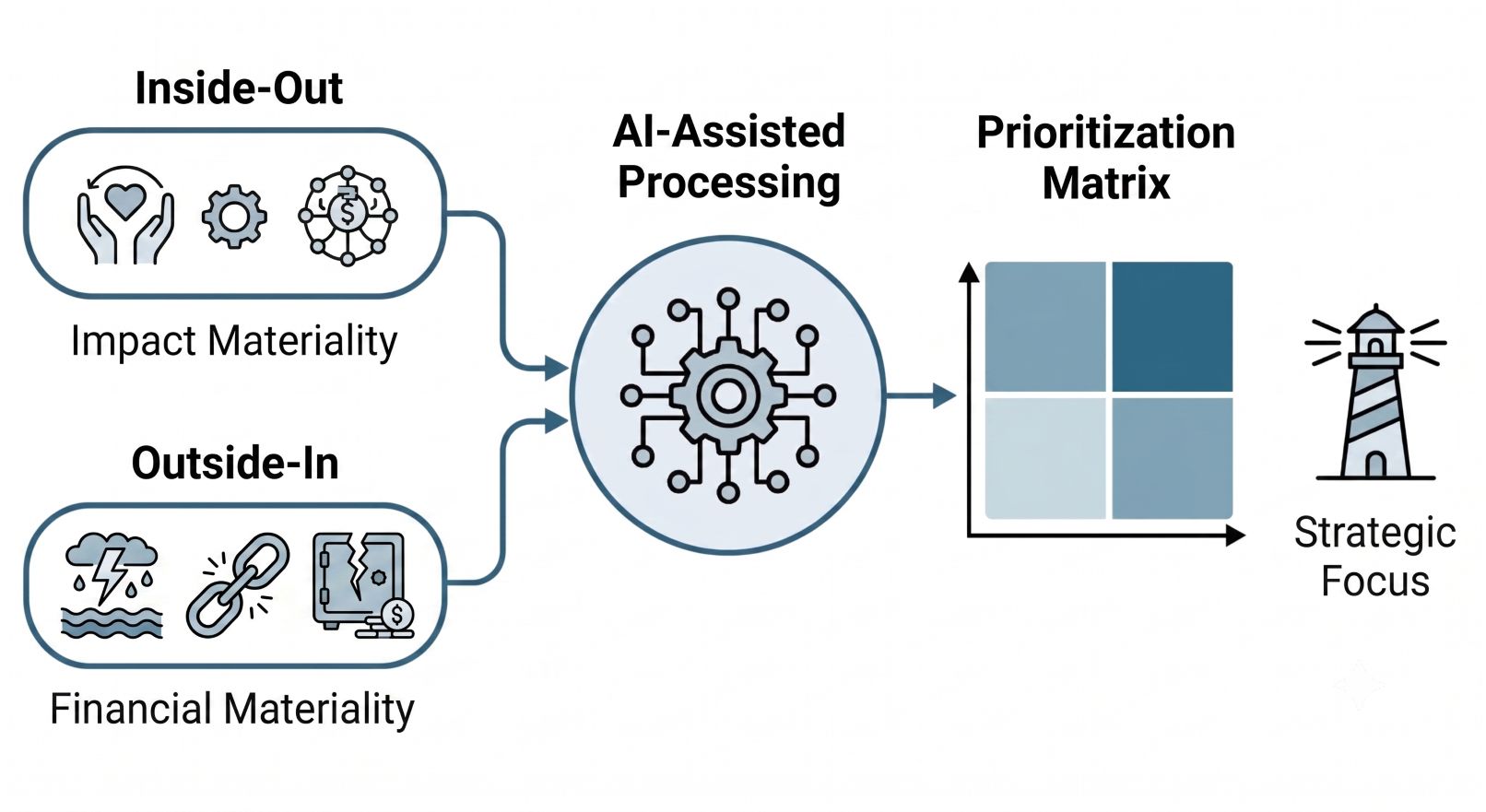
The largest American firms are used to navigating regional differences and will be fine. However, we are seeing a “double materiality” dilemma where U.S. firms in the EU must comply with the CSRD, requiring data on how they impact the world, not just how the world impacts them. Failing to bridge this gap risks fines of up to 4% of EU sales.
The real trend is a global “race to the bottom”. U.S. deregulation and the illogical use of tariffs are causing European regulators to loosen critical policies like CSDDD and EUDR. There is very little consistency across regulatory markets right now. American firms adopting these standards aren’t just being “green”; they are buying a license to operate in a global economy that is increasingly fragmented and volatile.
How has the manufacturing sector been uniquely impacted by sustainability pressures over the past year?
Manufacturing is at the sharp end of the “7 sources of waste”. High energy prices and tariff volatility have turned efficiency into a survival strategy. The biggest challenge is multi-tiered supply chain mapping—you can no longer just care about your direct supplier; you need to know where the energy for their raw materials originated.
For manufacturers that are also brands, a beyond-compliance sustainability program is a vital differentiation strategy. The biggest gap is that EHS and ESG are still not fully integrated. It’s just “Lean” rebranded. For those unsure where to start, our Manufacturing Self-Assessment helps identify where sustainability overlaps with Lean Six Sigma. If you can’t measure it, you can’t manage it—and in this economy, you certainly can’t afford to waste it.
What’s happening in the healthcare sector in relation to sustainability?
The healthcare and life sciences sector is one of the few seeing continued growth in sustainability, driven by waste reduction mandates and the need for efficient buildings. We’ve seen strong interest from the pharma value chain because sustainability is now a non-negotiable requirement of doing business in that ecosystem.
However, healthcare in the U.S. is a mess. Monthly insurance premiums for many families now equal their mortgage, and access is plummeting. Platforms that address affordability and access will see massive growth this year. I recommend focusing on “Care at Home” and digital platforms to reduce the energy footprint of brick-and-mortar facilities. In healthcare, a healthy environment and a healthy patient are two sides of the same coin.
Why are more organizations exploring fractional CSOs rather than building full in-house teams?
We’ve seen massive cost-cutting this year, and downsizing saps a company’s capacity to innovate. A full-time CSO is a fixed cost many mid-sized firms can’t justify.
Fractional CSOs make the biggest impact when a company hits a complexity wall—like mapping a multi-tiered supply chain for the first time or complying with the EU’s CSRD. It’s also vital for companies facing intense stakeholder pressure from investors or B2B buyers who don’t know how to translate those demands into an operational plan.
Another key instance is during leadership transitions or M&A. If you’re acquiring a company and need to quickly, surgically assess their climate risk or safety culture, a fractional CSO provides that expertise without the long-term commitment. We help organizations navigate these high-stakes moments when they lack the internal bandwidth to do it right.
If you could offer one piece of advice for C-level executives thinking about sustainability in 2026, what would it be?
When the federal government abandons the facts, the burden of maintaining a shared reality falls more directly upon the private sector. Are you ready to do your part?
In 2026, you cannot think about sustainability without thinking about your community—your employees, your neighbors, and the people in your supply chain. Sustainability is long-term planning, but that becomes very challenging to execute in our current social and economic conditions. So, what can you do? What can we do? Improve what you can influence. Find people in your community who need help and leverage your corporate assets to help them.
Stop using the word “ESG” if it’s a liability, but don’t stop doing the work. It can be helpful to narrow your efforts away from the broad ESG encyclopedia and focus on the tentpole issues where you can make a tangible impact. We recommend taking a look at the Shared Value framework—it forces leaders to eliminate performative bloat and focus on strategies that actually help.
Ask yourself every morning: “What is the one thing we can change today that will make us more successful, more resilient, and better for the community we depend on?” If we don’t acknowledge what’s at stake now, it will be too late.
About Adam Freedgood
Adam is a Principal and co-founder of Third Partners, where he helps organizations leverage ESG and sustainability to drive cultural change and growth. With a background in business development and hands-on corporate management experience, Adam leads ground-up sustainability planning programs for category-leading companies in various industries. He designs solutions to complex sustainability and business challenges, tailoring stepwise action plans based on a deep understanding of business risks, value drivers, and managerial dynamics. Adam holds a MS in Sustainability Management from Columbia University and a BS in Marketing from The Pennsylvania State University.
About the Author: Adam Freedgood