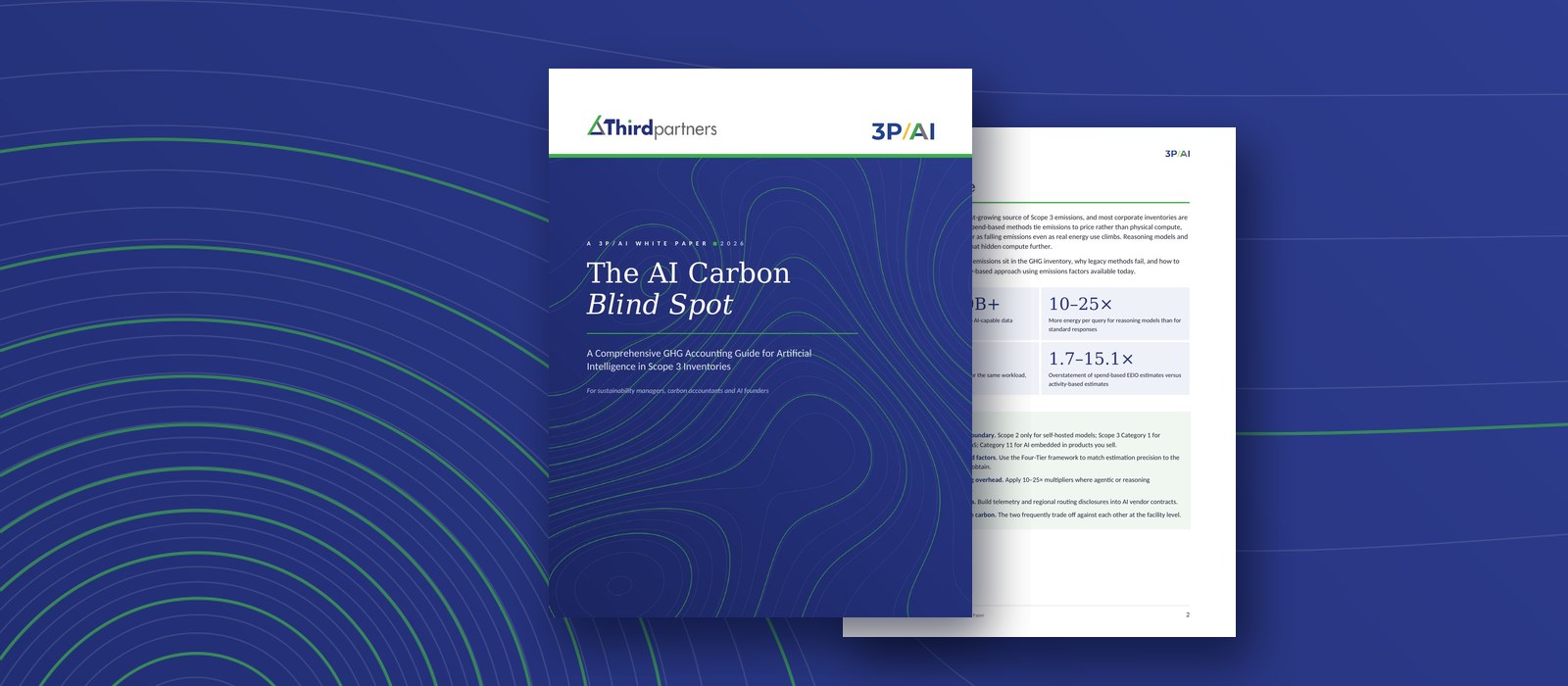
AI is now one of the fastest-growing sources of Scope 3 emissions, and most corporate inventories are not capturing it accurately. This free white paper from 3P/AI, the AI practice at Third Partners, explains where AI emissions sit in your greenhouse gas inventory, why legacy accounting methods miss them, and how to build a defensible, activity-based estimate with the data available today.
Why AI Is Breaking Scope 3 Accounting
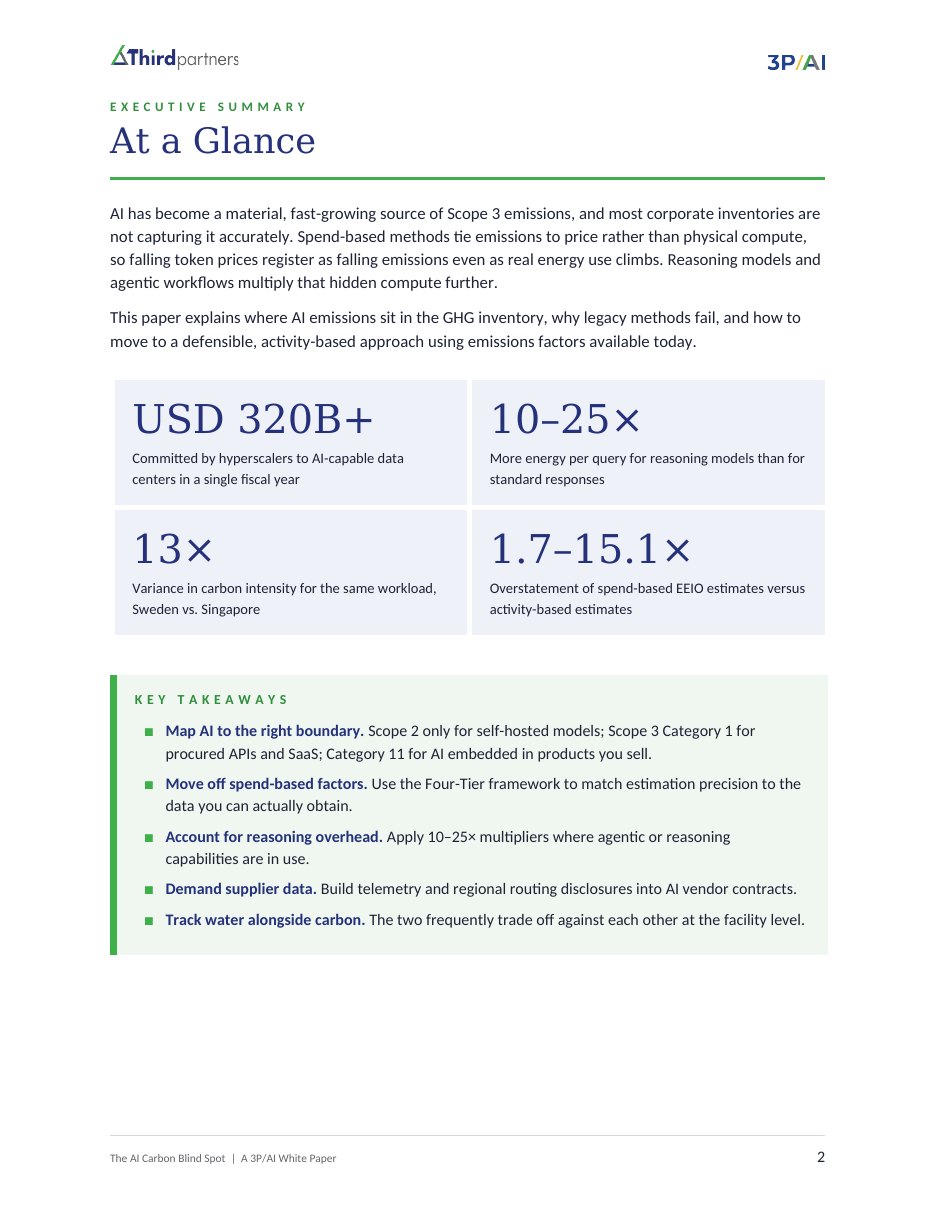
Most organizations account for AI the same way they account for any other software purchase: by multiplying spend by a generic emissions factor. That approach ties emissions to price rather than to the physical computing behind each query. As token prices fall, reported emissions fall with them, even when real energy use is climbing.
At the same time, reasoning models and agentic workflows are multiplying the hidden compute behind every answer, and where a model runs can change its carbon intensity by an order of magnitude. The result is a growing gap between what sustainability teams report and what is actually happening in the data center.
USD 320B+
Committed by hyperscalers to AI-capable data centers in a single fiscal year
10–25×
More energy per query for reasoning models than for standard responses
13×
Variance in carbon intensity for the same workload, Sweden vs. Singapore
1.7–15.1×
Overstatement of spend-based estimates versus activity-based estimates
Who This White Paper Is For
Sustainability Managers
Bring AI into your Scope 3 inventory with a method you can defend to auditors, customers and leadership.
Carbon Accountants
Replace spend-based factors with token-based emissions factors, formulas and data-quality guidance you can apply now.
AI Founders
Understand the disclosures your enterprise customers will ask for, and how your product shows up in their Category 11 emissions.
Inside the white paper
What You’ll Learn
- 01The Collision of Artificial Intelligence and Corporate Climate Commitments
- 02The Dual Vectors of AI Proliferation: Pushed Versus Pulled Workloads
- 03The Methodological Failure of Traditional GHG Accounting
- 04The Agentic Pivot: Token Inflation and the Physics of Reasoning
- 05Supply Chain Opacity, Geopolitics, and Routing Ambiguities
- 06Facility Metrics: PUE, CUE, WUE, and the 24/7 CFE Movement
- 07Hardware and the Embodied Carbon Iceberg
- 08Open Source Initiatives and GHG Database Innovations
- 09A Four-Tier Activity-Based GHG Accounting Methodology for AI
- EXSpend- and Activity-Based GHG Accounting Guide for AI Services
- 10Additional Research Questions and Future Directives
- 11Conclusion, plus 60 cited sources
Executive summary and key takeaways

The Four-Tier Framework

Exhibit 1: emissions factors by model class
Key Takeaways
A Preview: The Four-Tier Framework
The white paper’s core contribution is a decision framework for estimating AI emissions based on the quality of data you can get from each vendor.
TIER 1
Direct Provider DisclosuresFacility-level electricity, hourly clean-energy matching and per-model telemetry from the AI vendor. The gold standard, and the data to demand in contract negotiations.
TIER 2A
Token-Based Physical EstimationToken counts from API billing, matched to GPU energy benchmarks and regional grid carbon intensity.
TIER 2B
Proxy-Based Token EstimationFor seat-licensed tools like Microsoft 365 Copilot, where tokens are hidden: estimate usage from active users and workflow multipliers.
TIER 3
Spend-Based EEIO FallbackThe method of last resort when no usage data is available, with inflation adjustment and a clear plan to move up the tiers.
Download the White Paper
23 pages, including the Four-Tier Framework, emissions factors by model class, calculation formulas and 60 cited sources.
Bring AI Into Your Carbon Inventory With Confidence
Whether you are reporting AI emissions for the first time or trying to replace a spend-based estimate, the process does not have to be a guessing game. Third Partners can help you map where AI sits in your inventory, gather the right data from vendors, choose the right tier for each service, and build an estimate that will stand up to scrutiny.
Contact Third Partners to discuss your AI footprint, or learn more about our AI Sustainability Solutions.


About Third Partners
Founded in New York City in 2013, Third Partners is a boutique management consultancy working for positive change. Our clients are leaders within organizations where impact is critical to performance and brand equity.
3P/AI brings that expertise to artificial intelligence, helping companies measure and manage the footprint of the AI tools they buy, build and sell.
About the Author: Adam Freedgood