For privately held firms, conducting a double materiality assessment can often feel like a mandate designed for someone else. Unlike massive public companies equipped with dedicated investor relations teams and built-in compliance machines, private organizations rarely have the internal bandwidth to manage an exhaustive reporting process. Yet, the pressure is very real: you still need a rigorous, defensible sustainability strategy to remain accountable to key buyers, enterprise customers, and private investors. The problem? You simply don't have the time to manage a painstaking materiality process on your own, and you don't have the budget to pay a bloated, big-name consulting firm six figures to drag out the engagement for a year.
To solve this, Third Partners is thrilled to introduce our new AI-powered double materiality tool, part of our 3P/AI suite of sustainability consulting tools. Enhanced with generative AI and guided by expert sustainability consultants, this innovative service drastically reduces the time your organization spends preparing for, conducting, and producing a defensible, framework-aligned double materiality assessment.
Who Can Benefit from an AI-Powered Double Materiality Assessment?
Any organization with a mandate to refresh an outdated assessment or conduct their very first double materiality assessment will find immense value in the 3P/AI suite. This includes:
- Sustainability Directors and ESG Managers who are bottlenecked by the sheer volume of research required to benchmark peers and analyze industry trends.
- C-Suite Executives and Board Members seeking a defensible, data-backed understanding of business risks and opportunities to inform long-term corporate strategy.
- Compliance and Reporting Teams facing strict deadlines for upcoming regulatory or framework requirements.
If your internal teams are overwhelmed by the prospect of manual data collection and analysis, 3P/AI is designed to automate the heavy lifting so you can focus on strategy and action.
Seamless Compatibility with Global Frameworks
The sustainability reporting landscape is complex, but your materiality process shouldn't have to be. The 3P/AI double materiality tool is engineered to be fully compatible with the world's most rigorous reporting frameworks and standards.
European Corporate Sustainability Reporting Directive (CSRD)
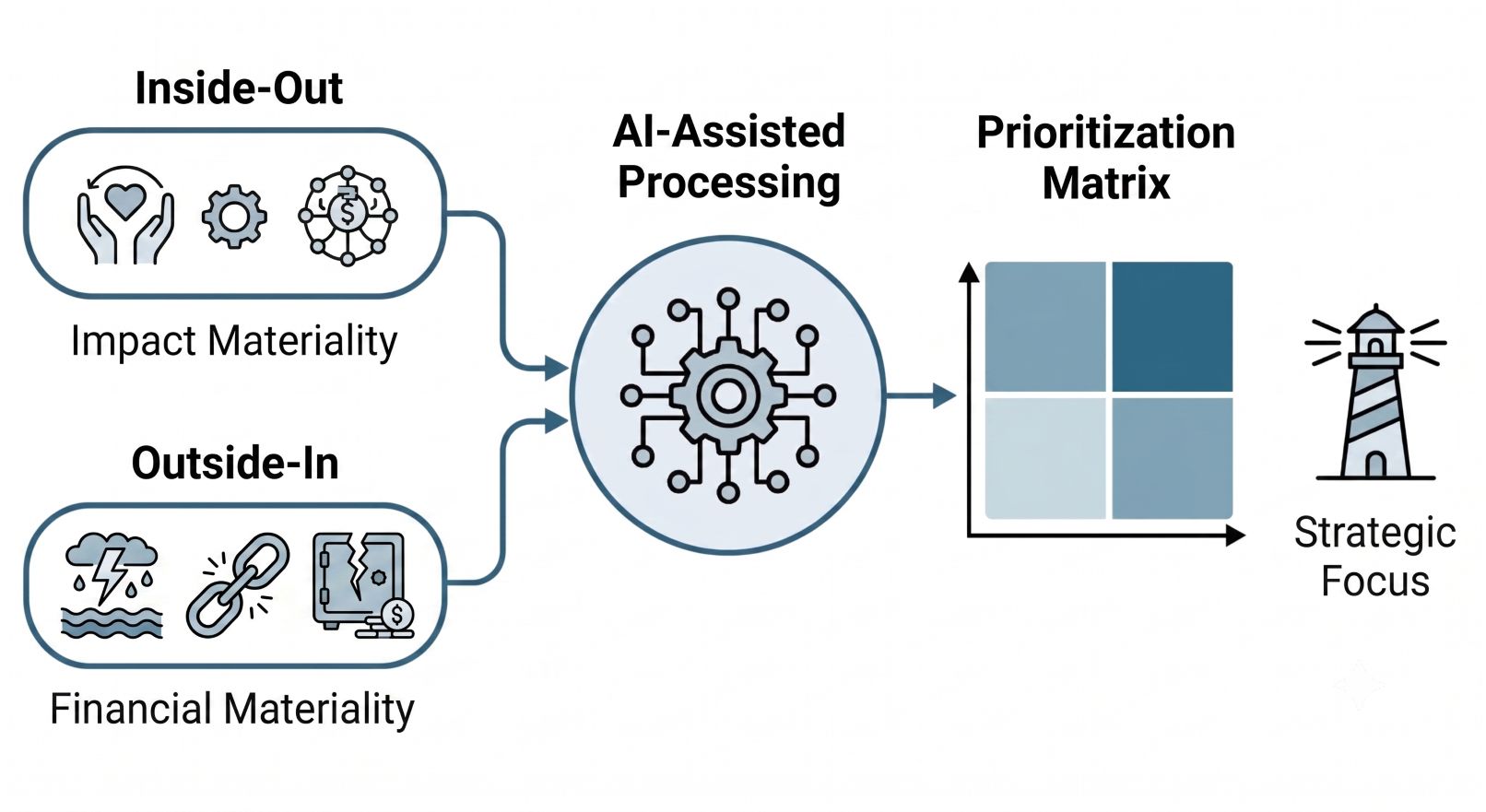
The CSRD has codified double materiality into law for thousands of companies. Our AI-powered tool ensures you capture both impact materiality (inside-out) and financial materiality (outside-in), satisfying the strict, granular requirements of the European Sustainability Reporting Standards (ESRS).
Global Reporting Initiative (GRI)
For organizations adhering to GRI standards, 3P/AI streamlines the identification of your organization's most significant impacts on the economy, environment, and people, ensuring your final assessment perfectly aligns with GRI's stakeholder-centric focus.
B Corp Certification (v2)
As B Lab rolls out its new standards, a formalized materiality assessment and board-level engagement are now required every three years for large and very large companies. Our tools provide the structured, defensible reporting required to validate your B Corp status and present clear findings to your leadership. Our process is designed to help you comply with the double (impact) materiality requirement, mandatory stakeholder engagement, severity-weighted scoring, and board oversight requirements.
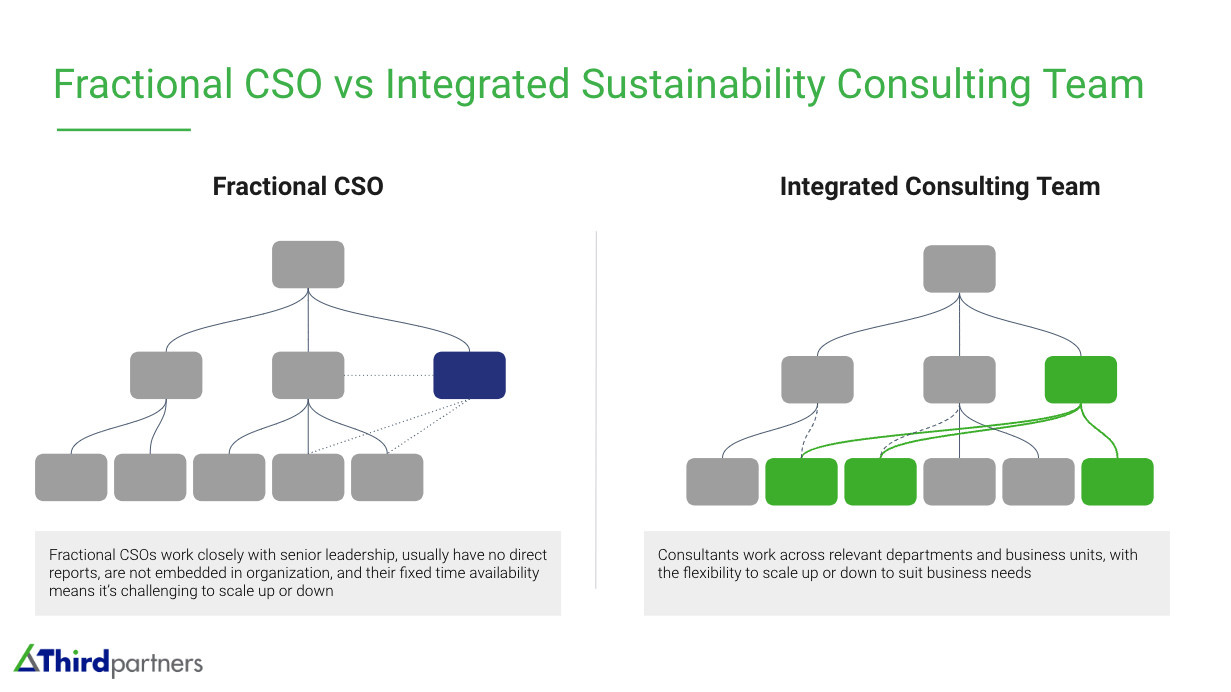
The Third Partners Difference: The Consultant in the Middle




The market is currently flooded with software-as-a-service (SaaS) providers offering automated ESG solutions that sound too good to be true. The reality? Pure software solutions often leave you abandoned with a generic dashboard, forcing your team to figure out the nuances of framework alignment and stakeholder engagement on their own.
When you work with Third Partners, there is always an expert consultant in the middle of the process.
We use 3P/AI to automate the painstaking research that analysts traditionally conduct, but a dedicated consultant is there to usher and shepherd you through every step. This hybrid approach—cutting-edge AI combined with deep human expertise—ensures your time is protected, your specific organizational nuances are understood, and you get the exact, high-quality results you expect.
How the 3P/AI Double Materiality Process Works
We have transformed a traditionally arduous months-long endeavor into a streamlined, highly efficient six-step process.
Step 1: Strategic Alignment and Onboarding
The process begins with a conversation. A Third Partners team member meets with your stakeholders to define the objectives of your materiality assessment. We map out the specific frameworks you need to adhere to (GRI, CSRD, B Corp, etc.), establish your preferred timeframe, and align on budget.
Step 2: Data Ingestion
Next, we feed the AI the foundational context of your business. We ingest a few simple but critical data points:
-
- Your past materiality assessments (if available).
- Prior sustainability reports and marketing materials.
- A curated list of peer companies and key competitors.
- A list of important stakeholders (e.g., specific non-profits, community groups in regions where you operate, investors, and key suppliers).
Step 3: Automated Synthesis and Preliminary Screening
This is where 3P/AI goes to work. The engine automatically analyzes hundreds of external sources—including competitor reports, industry benchmarks, and global sustainability trends. Within moments, it synthesizes a preliminary double materiality screening matrix and a comprehensive report outlining key topics, precise definitions, and their relative importance.
Step 4: Stakeholder Integration (The Inside-Out and Outside-In)
A defensible materiality assessment requires a comprehensive slate of stakeholder viewpoints. Using the preliminary list generated in Step 3, we draft tailored survey questions and conduct targeted stakeholder interviews.
Depending on your framework requirements, we then upload these interview notes, employee survey results, and other primary evidence directly into 3P/AI. The system analyzes how your stakeholders perceive:
-
- Financial Materiality (Outside-In): The influence of specific sustainability topics on your company’s financial performance and enterprise value.
- Impact Materiality (Inside-Out): Your company’s actual or potential impact on the economy, environment, and society.
Step 5: AI Scoring and Expert Refinement
Once stakeholder data is integrated, you will review a detailed materiality benchmarking report. At this stage, 3P/AI assigns an initial Impact Materiality Score and a Business Materiality Score to every single topic.
Instead of starting from a blank page, there is an intuitive interface to adjust the scoring, massage topic definitions to match your corporate voice, and finalize the data.
Step 6: Leadership Validation
The final step is finalizing your Materiality Matrix and Report. Armed with a defensible, data-backed document, companies can confidently run the assessment by executive leadership and the Board of Directors for final validation—a crucial step for compliance with standards like B Corp.
Unmatched Speed and Efficiency
By letting 3P/AI handle the tedious benchmarking and data synthesis, we drastically condense the project timeline:
- Rapid Assessments: From start to finish, an AI-assisted double materiality assessment can take as little as two weeks for smaller organizations with informal requirements.
- Comprehensive Assessments: If your organization has a complex reporting process requiring extensive global stakeholder interviews and survey distribution, you can expect a polished, final deliverable in 12 to 18 weeks.
Ready to Streamline Your Strategy?
Materiality doesn’t have to be a burden. With the 3P/AI suite, you get the speed and processing power of generative AI, backed by the strategic guidance of experienced sustainability consultants. You save time, reduce costs, and walk away with a highly accurate, framework-compliant roadmap for your sustainability journey.
FAQ
About the Author: John Haugen